Consultation On Hybrid Ban Post 2030

Friday, 14. May 2021

A consultation will be launched later this year to decide the distance a new hybrid electric vehicle can travel on zero emissions to remain on sale from 2030 to 2035.

Publishing its response today to a consultation on Ending the sale of new petrol, diesel and hybrid cars and vans, the Government also said it remained technology neutral and recognised that hydrogen could have a role to play.

Ministers confirmed in November 2020, that new petrol and diesel cars and vans would not be allowed to be sold in the UK from 2030.

New hybrid cars and vans that could drive a “significant distance” with no carbon coming out of the tailpipe, however, would be allowed to remain on sale until 2035.

The Office for Zero Emission Vehicle (OZEV) has previously explained that only plug-in and full hybrids will still be considered for sale from 2030 until 2035.

Full hybrids include the likes of the Toyota Prius and the Kia Niro, while mild hybrids, which are rapidly becoming the norm on most engines, are offered by Ford, with MHEV engines on the Fiesta, Puma and Focus.

In its response to the internal combsution engine (ICE) ban consultation, the Government says that it wants to increase the pace of transition to zero-emission driving.

“In doing so we recognise the importance of deploying a range of cleaner vehicle technologies from today up until the phase out dates,” it said.

“In particular, full hybrids and plug-in hybrids have a key role to play, both in reducing emissions and as a stepping-stone technology to help consumers and businesses adapt to zero emission driving.

“We are not banning the use of petrol and diesel cars and vans. These decisions only apply to new cars and vans. They do not apply to existing petrol, diesel and hybrid cars and vans which can continue to be driven and sold in the second-hand market.”

The Government says it recognises that a new target will be “challenging for different sectors of society and the economy”.

“Issues around affordability, range anxiety and infrastructure must be addressed to foster the willingness of drivers to transition to zero emission vehicles (ZEVs),” it added.

“Government takes a technology neutral approach on how this transition will be achieved. While it is true that battery electric vehicles (BEVs) dominate the current ZEV market, we recognise the potential of hydrogen as another solution for zero emission transport, particularly for heavier road vehicles.”

POSSIBLE DEROGATIONS

The Department for Transport (DfT) says that it will consider a “very limited range of derogations” to the phase out dates for specialist vehicles, including military service and emergency vehicles. A consultation on these derogations will be launched in due course.

It will also publish a delivery plan this year setting out major milestones towards the phase out dates and committed spending and regulatory measures. Progress against the plan will be monitored and reported publicly on an annual basis.

Furthermore, it will conduct a review of progress towards the phase out dates by 2025.

“Moving millions of vehicles to zero emissions is an enormous challenge,” said transport secretary Grant Shapps. “Government has already committed £1.5 billion to boost the early market, but now we are going further.

“We are backing our new phase out dates with over £2.8bn of investment to drive up the number of zero emission vehicles, accelerate the roll out of our world-class chargepoint infrastructure network, and to secure investment in gigafactories and other strategic technologies to develop the UK’s electric vehicle supply chain.”

In a Fleet News survey, conducted after the ICE ban was announced late last year, almost two-thirds of fleets said that implementing a ban on the sale of new petrol and diesel cars from 2030 was too soon.

The Government had previously said it would end the sale of new petrol and diesel cars and vans by 2040.  By Graham Hill thanks to Fleet News

Share My Blogs With Others: These icons link to social bookmarking sites where readers can share and discover new web pages.
  • MisterWong
  • Y!GG
  • Webnews
  • Digg
  • del.icio.us
  • StumbleUpon
  • Reddit
  • Alltagz
  • Ask
  • Bloglines
  • Facebook
  • YahooMyWeb
  • Google Bookmarks
  • LinkedIn
  • MySpace
  • TwitThis
  • Squidoo
  • MyShare
  • YahooBuzz
  • De.lirio.us
  • Wikio UK
  • Print
  • Socializer
  • blogmarks

Update On Mercedes Emissions Group Actions

Friday, 14. May 2021

Law firm Hagen Berman UK says it has filed proceedings against Daimler AG, Mercedes Benz Cars UK and Mercedes Benz Financial Services UK, in a bid to secure compensation payouts for drivers affected by emissions “cheating”.

The firm alleges that Mercedes programmed some of its diesel models produced between 2008 and 2018 to reduce the vehicles’ illegally high levels of nitrogen oxide when the vehicles were being tested for emissions.

In August last year, the German car maker agreed to pay a £560m settlement to owners in the USA after it was accused of cheating emissions tests.

Mercedes-Benz said cars sold in the US used different emissions control systems to those in Europe, however, and believes the claims brought forward by UK law firms are “without merit”.

Some 33,000 people in England and Wales have registered interest to have Hagens Berman represent them in the group litigation. The law firm says claimants can now formally opt in to join the case. Other interested parties are also still eligible to join.

“British consumers have a similar right to compensation for unlawful, deceptive and defective emissions-cheating implemented by Mercedes,” said Steve Berman, managing partner of Hagens Berman. “Following the $700 million US settlement against Mercedes, we spent the past year laying the foundation for equally successful litigation in the UK. We are now poised to hold Mercedes and other defendants to account.”

A number of car makers are being targeting by law firms for emissions cheating. Most recently, Harcus Parker announced it was investing all car makers that sold diesel models between 2009 and 2018. So far, no claims have been successful.

A 2016 investigation by the Vehicle Certification Agency, on behalf of the Department for Transport, found that only Volkswagen Group vehicles featured defeat devices designed specifically to beat official testing.

However, the tests provided further evidence that NOx emissions from diesel vehicles were higher in real-world conditions and on the test track than in laboratory conditions.

The investigation concluded that the EU regulations provided uncertainty about how emissions control systems may be reduced or deactivated in certain conditions and did not detail how the exceptions to the ban on defeat devices should apply, whether or how manufacturers should apply these exemptions, or how a type approval authority should evaluate the validity of their use. By Graham Hill thanks to Fleet News

Share My Blogs With Others: These icons link to social bookmarking sites where readers can share and discover new web pages.
  • MisterWong
  • Y!GG
  • Webnews
  • Digg
  • del.icio.us
  • StumbleUpon
  • Reddit
  • Alltagz
  • Ask
  • Bloglines
  • Facebook
  • YahooMyWeb
  • Google Bookmarks
  • LinkedIn
  • MySpace
  • TwitThis
  • Squidoo
  • MyShare
  • YahooBuzz
  • De.lirio.us
  • Wikio UK
  • Print
  • Socializer
  • blogmarks

Mitsubishi To Stop Selling New Cars In The Autumn 2021

Friday, 14. May 2021

Mitsubishi will sell new cars until the autumn, at which point it will transition to an aftersales only business, the company has confirmed.

It means new examples of models such as the Outlander plug-in hybrid (PHEV) and L200 pick-up will cease to be available by the end of the year.

The Japanese manufacturer unexpectedly announced it was pulling out of both the UK and European markets, last year.

At the time of the announcement a Mitsubishi spokesman told Fleet News: “Stock-wise we have access to a minimum of around 15,000 new vehicles across the entire range presently, with the option to order more L200 and Mirage stock further down the line, so we have no concerns in terms of vehicle supply for the foreseeable future.”

While some new vehicles will be procured by Mitsubishi from Alliance partner Renault, the company has confirmed that they will not be offered for sale in the UK and will not be produced in right-hand drive.

FLEET GUARANTEE

Both the Mitsubishi Outlander PHEV and L200 have proved popular with fleets, with the Environment Agency and Highways England just two of those impacted by the carmaker’s decision to wind up its UK and European operations.

The Environment Agency has been replacing its fleet of diesel vehicles with Mitsubishi Outlander PHEVs and has ordered 96 to date.

Dale Eynon, director of Defra Group Fleet Services, explained that the Outlander PHEV (commercial variant), in particular, has been a “vital part of our programme to reduce emissions, while maintaining full operational capability and being cost-effective”.

The manufacturer says has been contacting its fleet clients personally to offer them assurances.

“All our clients will be taken care of for as long as they are running our vehicles, that is a guarantee,” said the Mitsubishi spokesman.

Highways England has numerous Mitsubishi vehicles on its fleet, including a fleet of Mitsubishi Outlander PHEVs as asset delivery inspector vehicles. All have been bought outright.

Highways England said it was in talks with Mitsubishi about the vehicles on its fleet to “maintain business as usual. This includes the SMR for our fleet”.

SALES FIGURES

UK registrations from 2020, show Mitsubishi had sold 9,076 new vehicles, compared with 16,199 during the previous year.

The 43% decline in new registrations is more than the industry average, which dropped by 29% during the year.

The Mitsubishi Outlander PHEV, which has proved popular with company car drivers thanks to low benefit-in-kind (BIK) tax, was updated with new trim levels and a new infotainment system, last year. Prices started at £35,455 (on-the-road) for the revised plug-in hybrid SUV.

However, Government cuts to the plug-in car grant announced two years ago, meant the Outlander PHEV was no longer eligible.

The plug-in grant was cut by £1,000 and no longer applied to hybrid cars with a range of less than 70 zero-emission miles. The Government said the reduction in funding – from £4,500 to £3,500 – for the cleanest cars, and withdrawing the grant completely for the likes of the Outlander, was a sign of its success.

Its BIK tax savings credentials have maintained its traction in the market, however, with the Outlander outselling every other plug-in hybrid SUV on the market in 2020, with 3,336 Outlander PHEVs registered from January to December.

It means around a third of all new vehicles sold by the manufacturer last year was an Outlander PHEV and more than 53,000 examples have now been registered in the UK.

£1.3 BILLION LOSS

That sales success, however, comes after Mitsubishi reported a £1.3 billion loss in the first quarter of 2020, resulting in its decision to focus on faster growing, more profitable markets, with the aim of cutting costs by 20% over the next three years.

“The company is effectively pulling out of Europe to focus on the likes of south Asian markets,” said David Bailey, professor of business economics at the Birmingham Business School and senior fellow at UK in a Changing Europe.

Along with exiting UK and European markets, Mitsubishi will aim to improve its bottom line by cutting R&D spend, undertaking ‘salary reviews’ and shutting one of its plants in Japan by next year.

Its European manufacturing operations at the Nedcar plant in the Netherlands were sold in 2012, with cars, instead, imported to Europe.

Planned new models the EU and UK will miss out include a new Outlander SUV and a new Battery Electric SUV (2021), a plug-in hybrid Outlander and L200 Pick up (2022), and the Xpander MPV and Pajero Sport SUV (2023).

Bailey added: “From a consumer point of view, the pull-out is a great shame as the firm has pioneered plug-in hybrid technology in the UK and Europe.”

Bailey believes that the technology will probably find its way into new Renault-Nissan-Mitsubishi Alliance models from Renault and Nissan.

“While the Alliance plan had anticipated a refocusing by Mitsubishi on south-east Asia, I’m still surprised that Mitsubishi is effectively leaving the UK/EU market completely,” he said.

“I had anticipated Mitsubishi models being assembled off the same platforms as Renault and Nissan models, and produced, for example, at Sunderland, so as to maximise the alliance’s market share in the region.”

However, Bailey doesn’t rule out the brand being resurrected in the UK market in this way at some point.

IMPACT ON RVs

Pricing experts at Cap HPI have played down the potential of Mitsubishi’s decision to exit the UK having a negative impact on residual values (RVs).

Andrew Mee, head of forecast UK at Cap HPI, told Fleet News: “It’s important to remember that Mitsubishi is an established brand with some popular models, notably Outlander and L200, and we expect these to continue to be attractive as used cars.

“While some funder and lender nervousness can be expected around residual values, there have been precedents of brands exiting the UK without values suffering, and these include MG Rover, Saab, Daewoo and Chevrolet.

“In all cases, values subsequently moved in line with market and sector trends and were not adversely affected by the brand’s withdrawal.”

Mee argues that the expected availability of spare parts and the knowledge and experience of service engineers should help used sales and values.

Furthermore, he says it’s even possible that, as there will be a finite number of Mitsubishi cars registered in the UK, as volumes on the road decrease over time, then interest from loyal customers could have a “positive impact on used values”. By Graham Hill thanks to Fleet News

Share My Blogs With Others: These icons link to social bookmarking sites where readers can share and discover new web pages.
  • MisterWong
  • Y!GG
  • Webnews
  • Digg
  • del.icio.us
  • StumbleUpon
  • Reddit
  • Alltagz
  • Ask
  • Bloglines
  • Facebook
  • YahooMyWeb
  • Google Bookmarks
  • LinkedIn
  • MySpace
  • TwitThis
  • Squidoo
  • MyShare
  • YahooBuzz
  • De.lirio.us
  • Wikio UK
  • Print
  • Socializer
  • blogmarks

New Laws Being Debated To Cover Autonomous Cars

Friday, 14. May 2021

Recommendations for who will be legally liable if an autonomous vehicle is involved in a collision or commits an offence are set to be published by the Law Commission before the end of the year.

The organisation has completed a consultation into the legal ramifications of the technology and is now assessing responses before making its final recommendations.

Jessica Uguccioni, lead lawyer of the Law Commission’s autonomous vehicles review, says: “One of the big things we’ve determined is that you can’t just keep the current system for enforcing road traffic rules when it comes to automated vehicles.

“At the moment you can basically lock people up if they do something really, really bad on the road, like dangerous driving, but that is just not going to work with the automated driving regime.

“We need to have a system which is much more based on ensuring safety to begin with, but then understanding why things have gone wrong and preventing them happening again because a single incident can have ramifications for many other vehicles.”

In the Law Commission’s consultation document, the organisation says different levels of automation should affect where liability lies.

If the vehicle is fully autonomous and can travel without a driver in them then any people in the vehicle are merely passengers so have no legal responsibility for the way the vehicle drives and are under no obligation to take over the driving.

Determining liability for autonomous vehicles which require a human driver to be in control of the vehicle at times is more complicated.

While there will be periods when the vehicle is fully autonomous or when it is being fully controlled by a human, there will also be times when the vehicle is transferring control to the driver.  By Graham Hill thanks to Fleet News

Share My Blogs With Others: These icons link to social bookmarking sites where readers can share and discover new web pages.
  • MisterWong
  • Y!GG
  • Webnews
  • Digg
  • del.icio.us
  • StumbleUpon
  • Reddit
  • Alltagz
  • Ask
  • Bloglines
  • Facebook
  • YahooMyWeb
  • Google Bookmarks
  • LinkedIn
  • MySpace
  • TwitThis
  • Squidoo
  • MyShare
  • YahooBuzz
  • De.lirio.us
  • Wikio UK
  • Print
  • Socializer
  • blogmarks

Greater Education Is Needed As Drivers Of Plug-In Hybrids Fail To Minimise Running Costs

Thursday, 8. April 2021

A warning has been issued to fleet operators who are turning to Plug-In Hybrid (PHEV) cars without instructing their drivers as to how to get the most out of them. Some advice is the same for drivers of PHEV’s generally so I thought it would benefit all my readers by including here.

It reminded me of a very early case whereby a large company, having read of the benefits to the environment and seeing fuel consumption figures of over 140mpg they moved most of their company car fleet over to the newly launched Mitsubishi Outlander.

Their fleet manager was astonished to see average MPG figures of 27, much less than they had achieved with their diesel fleet. They had overlooked the fact that drivers needed the facilities at home or at work to plug-in the cars to an electric supply in order to achieve the high numbers of miles per gallon. Most cars were not being plugged in at all with drivers believing that the cars would self-charge anyway.

Here is what Fleet News says:

Employers need to undertake due diligence on driver charging facilities as electric vehicles (EVs) start to make their way onto fleets in larger numbers, says the Association of Fleet Operators (AFP).

Chair Paul Hollick said that this was especially important for drivers of petrol hybrid electric vehicles (PHEVs) who could potentially choose not to charge them and instead continually fuel up at the pump.

He explained: “Our members are rapidly gaining practical experience of operating EVs and one of the things that is becoming clear is that you can’t just have a short chat with a driver about the fact that they want to adopt an EV as their company car and then hand them the keys.

“Fleets need to ensure that drivers have a good understanding of their charging options, have their own charging facilities that are not just a standard socket and, in the case of PHEVs, will always charge the car even when there is option to avoid doing so.

“It’s a case of carrying out some basic due diligence so that you are gaining the maximum operational and environmental benefit from EVs and PHEVs, while minimising some of the potential pitfalls.”

In most cases drivers are paying for their own home charger although, in some cases with larger employers, a third party will provide installation on some kind of preferential terms.

However, there is a different picture for drivers of electric vans, where most employers are paying for the charger to be installed on the basis that it is a job-need requirement that they are effectively stipulating.

Sometimes, the fitting of the charger is being added to the monthly lease rate in order to provide a higher degree of affordability.

Hollick added that some fleets were stipulating that EV and PHEV drivers should sign a declaration covering basic points of vehicle operation.

“These employers are asking their drivers to ensure that they keep their vehicle adequately charged, that they have a charger available on their drive and even, where there is only on-street parking, that some form of charger is easily available.

“The conditions for PHEVs are tighter. We’ve all come across a few instances in recent years where drivers have chosen these vehicles to minimise personal taxation and then used them purely as an internal combustion engined car. This makes them extremely expensive to operate and destroys any environmental advantage. Analysis shows that a poorly used PHEV is more expensive to operate than a petrol of diesel equivalent.

“Creating a declaration that electric power will be used as often as possible for PHEVs is a potentially effective solution to this issue and something that we have seen a number of fleets now adopt. It makes the driver aware of their responsibilities and that shows them that their employer takes these matters seriously.”  By Graham Hill thanks to Fleet News

Share My Blogs With Others: These icons link to social bookmarking sites where readers can share and discover new web pages.
  • MisterWong
  • Y!GG
  • Webnews
  • Digg
  • del.icio.us
  • StumbleUpon
  • Reddit
  • Alltagz
  • Ask
  • Bloglines
  • Facebook
  • YahooMyWeb
  • Google Bookmarks
  • LinkedIn
  • MySpace
  • TwitThis
  • Squidoo
  • MyShare
  • YahooBuzz
  • De.lirio.us
  • Wikio UK
  • Print
  • Socializer
  • blogmarks

Nearly Half Of Drivers Dangerously Ignore Vehicle Warning Lights

Thursday, 25. February 2021

A survey of 2,000 UK adults has revealed that 46% of drivers ignore the alerts.

One in five claim they will drive for two or three days before investigating issues.

Two in five ignore them hoping they’ll go off and a third leave them in fear of expensive repair bills.

Motorists are being warned to not ignore illuminated dashboard warning lights in their cars when they return to the road after – or during – the third national lockdown.

A survey of 2,000 UK adults by dealer group Robins & Day revealed that almost half fail to immediately address the alerts, with many neglecting them out of laziness.

And by continuing to use their car when a warning light is telling them not to, motorists are risking causing more damage to their motors and could see repair costs spiral.

The dealer network’s poll found that 46 per cent of adults ignore a warning light on the dashboard of their car.

Of the 2,000 people surveyed, 19 per cent said they would continue to use their vehicle for two or three days with a warning light illuminated before seeking to get the problem sorted.

This is the case even if the warning light is red to signify it is a serious issue that need immediate action.

Amber, orange or other colour lights often mean something needs checking by a garage but the vehicle can still be driven.

When asked why they don’t action the warnings by taking the car to a dealership or garage, two in five (40 per cent) said they disregard it as a fault with the dashboard light itself, expecting it to go off again sooner or later.

Incredibly, over a third (34 per cent) try to push it to the back of their mind over fears of expensive repairs, while another quarter (24 per cent) cast the issue aside out of sheer laziness.

Explaining the results of its study, the dealer group said: ‘Whilst it is completely reasonable not to know every single light on a dashboard, ensuring you have enough knowledge of the basics to help you diagnose a potential problem with your vehicle will prove to be a priceless skill, should an issue arise.

‘However, our study found that just a fifth (21 per cent) of UK drivers could identify the basic warning lights on their dashboard such as ‘low tyre pressure’ and ‘check oil’. Fifteen per cent of those surveyed believed they could identify all of the basic warning lights unaided, if required.

‘Our research also highlighted that three per cent of Brits did not know that their car manual was there to help them to identify any issues with their vehicle.’

You could fail an MOT

While failing to remedy a dashboard warning light can cause a more expensive problem, it can also cause issues if you’re taking your car for an MOT test.

Under current rules, some warning lights can result in an automatic fail.

These include alerts for problems with airbags, the electronic parking brake, electronic stability control, headlight main beam, electronic power steering, brake fluid level or issue with the seatbelt pre-tensioner.

The Law & Your Insurance

Failing to investigate the cause of a dashboard warning light is also illegal. More than one in ten drivers (12%) do not know this and 10% are unaware it can invalidate their insurance policy, according to Robins & Day.  By Graham Hill thanks to This Is Money & Robins &Day

Share My Blogs With Others: These icons link to social bookmarking sites where readers can share and discover new web pages.
  • MisterWong
  • Y!GG
  • Webnews
  • Digg
  • del.icio.us
  • StumbleUpon
  • Reddit
  • Alltagz
  • Ask
  • Bloglines
  • Facebook
  • YahooMyWeb
  • Google Bookmarks
  • LinkedIn
  • MySpace
  • TwitThis
  • Squidoo
  • MyShare
  • YahooBuzz
  • De.lirio.us
  • Wikio UK
  • Print
  • Socializer
  • blogmarks

Massive Drop In New Car Registrations In 2020

Monday, 8. February 2021

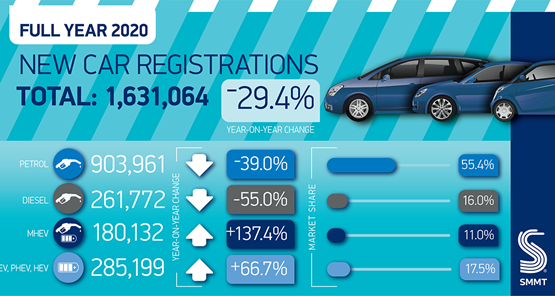
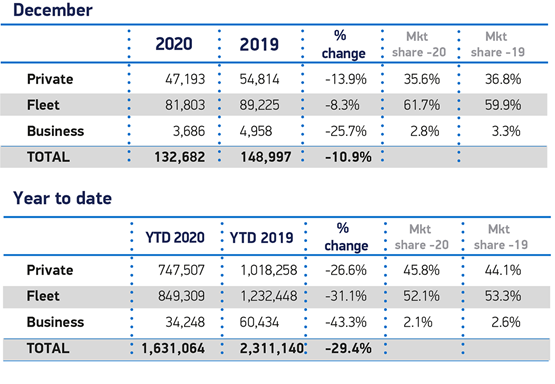
I don’t think that it would surprise anybody that new car registrations were drastically down in 2020 but the interesting statistic is the split of cars. Private registrations suffered the least with the larger fleets doing slightly better but the business registrations were down 43.3% (see chart below).

However, I would suggest that whilst these figures look dreadful many customers, both corporate and consumer extended lease contracts last year and those that had to change their cars decided to go down the used car route as there was a grave lack of new car stock available.

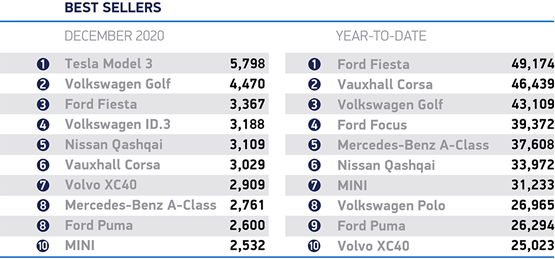
Here is the report and breakdown of the figures for 2020:

Fleet and business registrations fell by 32% in 2020, with 400,000 fewer company cars registered compared to 2019, but fleets were behind a massive increase in the uptake of electric vehicles (EVs).

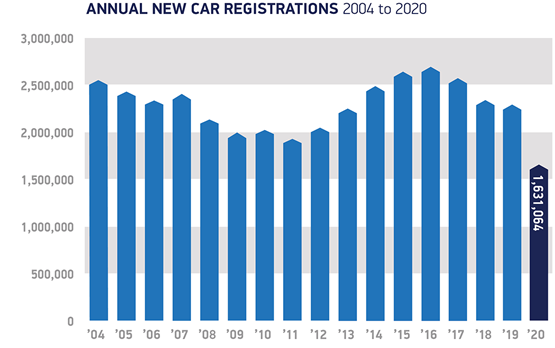
The new figures, published today by the Society of Motor Manufacturers and Traders (SMMT), show overall demand in the new car market fell to the lowest level since 1992.

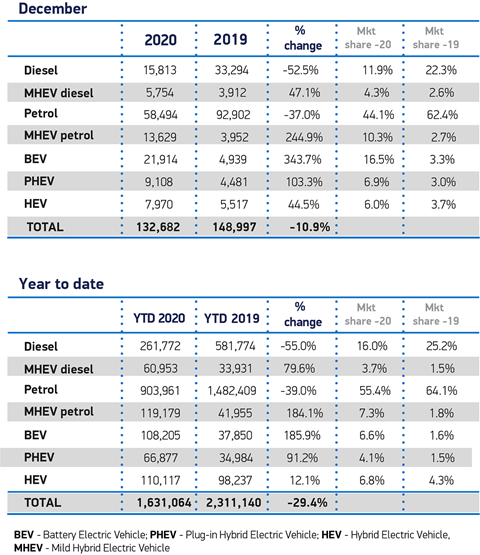
They also reveal the continuing decline of diesel, with 55% fewer diesel cars registered in 2020 compared to 2019.

The SMMT sales figures show there were 883,557 cars registered to fleet and business during 2020, compared to almost 1.3 million vehicles the previous year.

However, the latest sales data also reveals that in December, fleet and business registrations were only 9% down compared to December 2019.

It suggests a recovering company car market, with 85,489 fleet and business registrations, equating to 64% market share.

https://cdn.fleetnews.co.uk/web/1/root/smmt-registrations-2020_w555_h555.png

Overall, the UK new car market fell by almost a third (29%) in 2020, with annual registrations dropping to 1,631,064 units.

Against a backdrop of Covid-19, the industry suffered a total turnover loss of some £20.4 billion, with private vehicle demand falling by 27% overall, amounting to a £1.9bn loss of VAT to the Exchequer, says the SMMT.

Mike Hawes, chief executive of the SMMT, says that 2020 will be seen as a “lost year” for automotive, with the sector under “pandemic-enforced shutdown” for much of the year and uncertainty over future trading conditions taking their toll.

However, he said: “With the rollout of vaccines and clarity over our new relationship with the EU, we must make 2021 a year of recovery.

“With manufacturers bringing record numbers of electrified vehicles to market over the coming months, we will work with Government to encourage drivers to make the switch, while promoting investment in our globally-renowned manufacturing base – recharging the market, industry and economy.”

https://cdn.fleetnews.co.uk/web/1/root/smmt-december-and-year-to-date_w555_h555.png

Demand fell across all segments bar specialist sports, which grew by 7%, although Britain’s most popular class of car remained the supermini, retaining a 31% market share despite a 26% decline in registrations.

Meanwhile, although falling by a combined 33%, petrol and mild hybrid (MHEV) petrol cars made up 63% of registrations, while diesel and MHEV diesels, down 48%, comprised almost a fifth of the market.

Fleets adopt more electric vehicles

Battery and plug-in hybrid electric cars accounted for more than one in 10 registrations – up from around one in 30 in 2019.

Demand for battery electric vehicles (BEVs) grew by 186% to 108,205 units, while registrations of plug-in hybrids (PHEVs) rose 91% to 66,877.

Most of these registrations (68%) were for company cars. Gerry Keaney, chief executive of the British Vehicle Rental and Leasing Association (BVRLA), says that 2020 has been a “tipping point” for EV uptake and demonstrates what can be achieved when Government works closely with fleets to develop a set of powerful grants and tax incentives and invest in a robust public charging network.

“While only a handful of EVs were on sale in 2011, there are now more than 100 models available.” Poppy Welch, head of Go Ultra Low

“The latest BVRLA data shows that the fleet sector continues to lead the charge towards zero emission motoring, with battery electric vehicles responsible for 21% of company car registrations in the three months to October 2020.”

With so much uncertainty surrounding the impact of EU Exit, coronavirus and the economic downturn, Keaney says that the Government must do everything it can to support the vehicle buyers that underpin the UK’s new car market.

“With the next Budget just weeks away, the Chancellor must continue to ring-fence the long-term grants and tax incentives that make electric vehicles affordable,” he said.

“He must also resist the urge to pile more motoring tax increases on fleets and drivers that have yet to make the transition to zero emission motoring.

“Many of these businesses and individuals are struggling financially and can’t yet find an electric vehicle that meets their needs or budget.” 

More than 100 plug-in car models are now available to UK buyers, and manufacturers are scheduled to bring more than 35 to market in 2021 – more than the number of either petrol or diesel new models planned for the year.

Poppy Welch, head of Go Ultra Low, believes that in the context of the new car market, 2020 will be remembered as the breakthrough year for EVs.

“After a ninth successive year of growth in EV registrations, we’ve now seen market share rise to 10.7%,” she said.

“This has been made possible, in large part, by the Government’s ongoing support and long-term vision, combined with the automotive industry’s commitment to developing a wide range of zero-emissions vehicles that are clearly convincing the public with their performance, financial and environmental credentials.

“While only a handful of EVs were on sale in 2011, there are now more than 100 models available.”

When will the market get ‘back on its feet?

Ashley Barnett, head of consultancy at Lex Autolease, said that the 29% year-on-year drop really “hammers home” just how challenging the coronavirus pandemic has been for the motor industry.

“The market will take some time to get back on its feet,” he said. “How long that is remains to be seen.”

He added: “The growth in EVs is comforting but ultimately is from an extremely low base – only 6.6% of vehicles on the roads are EVs (including PHEVs).

“All eyes will be firmly on the spring Budget and the rumoured plans for a road pricing scheme which may go some way to recoup lost tax revenue when EVs begin to overtake conventional ICE models.

“The Chancellor has an opportunity to reassure would-be EV drivers that fiscal incentives will remain on the table and incentivise them to take the first step into alternatively-fuelled vehicles.”

Jon Lawes, managing director of Hitachi Capital Vehicle Solutions, expects economic uncertainties to continue into the first quarter of 2021, while the pandemic dampens consumer confidence.

However, he said: “The UK’s long negotiated tariff-free trade agreement with the EU should provide a welcome boost for the motor industry to lay the foundations to support a recovery in the sector.

“Similarly, the positive trend in EV uptake demonstrates that the transition to electric will gather momentum in the months ahead heightened by the wide range of new EV models coming to market in 2021 and growing consumer demand.”

https://cdn.fleetnews.co.uk/web/1/root/smmt-december-registrations_w555_h555.png
https://cdn.fleetnews.co.uk/web/1/root/smmt-year-on-year-registrations_w555_h555.png
https://cdn.fleetnews.co.uk/web/1/root/smmt-december-best-sellers_w555_h555.png

By Graham Hill thanks to Fleet News & SMMT

Share My Blogs With Others: These icons link to social bookmarking sites where readers can share and discover new web pages.
  • MisterWong
  • Y!GG
  • Webnews
  • Digg
  • del.icio.us
  • StumbleUpon
  • Reddit
  • Alltagz
  • Ask
  • Bloglines
  • Facebook
  • YahooMyWeb
  • Google Bookmarks
  • LinkedIn
  • MySpace
  • TwitThis
  • Squidoo
  • MyShare
  • YahooBuzz
  • De.lirio.us
  • Wikio UK
  • Print
  • Socializer
  • blogmarks

SUV Sales Across Europe Drop For First Time In 6 Years

Monday, 8. February 2021

SUV Sales Across Europe Drop For First Time In 6 Years

The growth in demand for SUVs across Europe has slowed for the first time in six years as smaller, electrified models start to claw back sales.

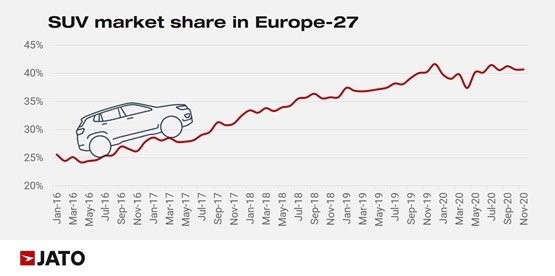
Between January 2016 and January 2020, the market share of SUVs grew significantly – from 25% to 40%.

For the majority of the year, the market share of SUVs remained stable – between 40% to 41%. However, their registrations fell by 13% in November, and 21% YTD when compared to 2019.

https://cdn.fleetnews.co.uk/web/1/root/jatoeuropeanvolumespressrelease-november2020-final-suv-market_w555_h555.jpg

Felipe Munoz, global analyst at JATO Dynamics, said: “The market has benefitted hugely from a wider SUV offering provided this year. But with the impact of Covid-19 still in full force, demand is no longer growing in parallel to new product launches, nor at such a fast pace.”

Conversely, B and C cars experienced declines below the overall average, in fact, their market share increased in November due to new arrivals and a more competitive electrified offering.

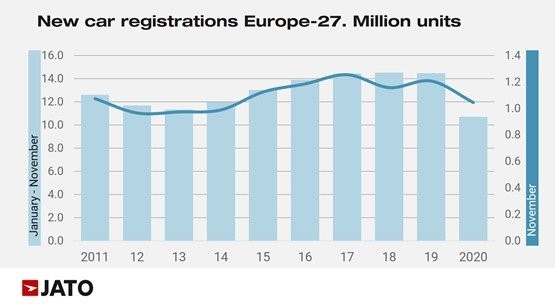
Overall, Europe registered 1,045,129 new cars – 13% less than for the same period in 2019. November 2020 has recorded the lowest volume since 2014, when just 989,500 units were registered.

https://cdn.fleetnews.co.uk/web/1/root/jatoeuropeanvolumespressrelease-november2020-final-year-on-year-registrations_w555_h555.jpg

Year-to-date figures continue to point to a downward trend, with YTD volume dropping by 26%. European consumers registered 10.71 million units between January and November – the lowest YTD figures so far this century.

Munoz added: “The global pandemic and its impact on mobility has been extremely painful for the automotive industry, indeed more painful than any other economic crisis that has hit Europe over the last two decades.”

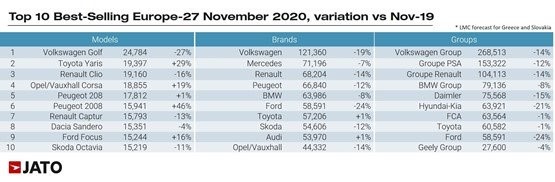
The overall ranking by models in November confirms that the Volkswagen Golf (pictured) kept its position as the most popular car in Europe. The hatchback registered 24,800 units in November – just short of 255,000 units since January.

Only two SUVs made it into the top 10 – the Peugeot 2008, followed by the Renault Captur. Further down the ranking, Ford Puma, Volvo XC40, Audi A3, Renault Zoe, Volkswagen ID3, Kia Niro, Mercedes GLA, Skoda Kamiq, Jeep Compass, Mercedes GLB, Nissan Juke, Audi Q3 Sportback, Kia Xceed, Suzuki Ignis, and BMW 2-Series, all posted healthy results.

https://cdn.fleetnews.co.uk/web/1/root/jatoeuropeanvolumespressrelease-november2020-final-best-sellers_w555_h555.jpg

By Graham Hill thanks to Fleet News

Share My Blogs With Others: These icons link to social bookmarking sites where readers can share and discover new web pages.
  • MisterWong
  • Y!GG
  • Webnews
  • Digg
  • del.icio.us
  • StumbleUpon
  • Reddit
  • Alltagz
  • Ask
  • Bloglines
  • Facebook
  • YahooMyWeb
  • Google Bookmarks
  • LinkedIn
  • MySpace
  • TwitThis
  • Squidoo
  • MyShare
  • YahooBuzz
  • De.lirio.us
  • Wikio UK
  • Print
  • Socializer
  • blogmarks

DVLA Warn About Increase In Scam Emails By 600%

Monday, 8. February 2021

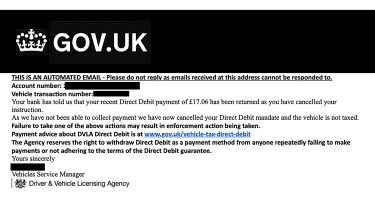
The following is just one of a series of emails being sent to drivers by scammers in order to defraud them.

https://media.autoexpress.co.uk/image/private/s--46YtAi95--/f_auto,t_content-image-full-mobile@1/v1607700527/autoexpress/2020/12/DVLA%20scam%20emails.jpg

The Driver and Vehicle Licensing Agency (DVLA) has seen a six-fold increase in scam reports. Between July and September 2020, the DVLA received 603 per cent more reports of fraudulent emails, texts and phone calls than it did in the same period last year.

There were 3,807 reports of email scams alone – up 531 per cent from the 603 reported in the three months to September 2019. Reports of fraudulent texts, though, decreased from a 653 between July and September 2019 to 510 in the same period this year.

These fraudulent messages can ask drivers to verify their driving licence details, offer vehicle tax refunds, or highlight a failed vehicle tax payment and ask for bank details.

The DVLA has now released images of some of the most commonly reported fraudulent emails, allowing drivers to familiarise themselves with them and avoid them.

How to protect yourself against the scammers

Drivers are reminded that the only place they can access official information on the DVLA and its services is the GOV.UK website. The DVLA never asks for bank details over email and never sends text messages about vehicle tax refunds.

The DVLA also tells motorists to never share driving licence images and vehicle documents online, never share bank details or personal data online, avoid websites offering to connect to DVLA’s contact centre and only use GOV.UK when looking for DVLA contact details.

Suspicious emails and texts should be reported to the National Cyber Security Centre. You can also forward a questionable text message to your mobile network provider on 7726. Furthermore, anyone who thinks they may have been a victim of fraud should immediately contact the police via Action Fraud.

Phil Morgan, head of fraud policy investigation at the DVLA, said: “These new figures demonstrate that scammers are becoming more persistent in their efforts to target motorists.

“These more recent scams may at first seem legitimate, however they are designed to trick motorists into providing their personal details. We never ask for bank or credit card details via text message or email, so if you receive something like this, it’s a scam.”  By Graham Hill thanks to AutoExpress

Share My Blogs With Others: These icons link to social bookmarking sites where readers can share and discover new web pages.
  • MisterWong
  • Y!GG
  • Webnews
  • Digg
  • del.icio.us
  • StumbleUpon
  • Reddit
  • Alltagz
  • Ask
  • Bloglines
  • Facebook
  • YahooMyWeb
  • Google Bookmarks
  • LinkedIn
  • MySpace
  • TwitThis
  • Squidoo
  • MyShare
  • YahooBuzz
  • De.lirio.us
  • Wikio UK
  • Print
  • Socializer
  • blogmarks

As Electric Vehicles Increase Government Looks Set To Introduce ‘Tax Per Mile’!

Wednesday, 27. January 2021

The Government is being urged to work with the fleet sector to ensure any changes to motoring taxation are carried out in a timely, effective and proportionate way.

Reports suggested that the Government was considering reviving road pricing plans to counter lost tax revenues from the increasing adoption of electric vehicles (EVs).

The fleet sector has already shown it is receptive to road pricing as a replacement to other road and fuel duties. Fleet News has been calling for the Government to launch a feasibility study since its Fleet Industry Manifesto report in 2015.

The National Infrastructure Strategy, launched to coincide with the Spending Review, emphasised the need for motoring tax revenues to ‘keep pace’ with the uptake of EVs. It did not, however, mention road pricing as a potential alternative to the current regime.

Gerry Keaney, chief executive of the British Vehicle Rental and Leasing Association (BVRLA) says any changes need to be fair to the fleet industry.

He recognises that the Government’s future motoring tax strategy must strike a “fine balance” in maintaining vital revenues and encouraging people into newer and cleaner vehicles.

But he stressed: “The Government must avoid placing a crushing tax burden on businesses and individuals that are unable to upgrade their cars, vans or trucks and are already struggling to cope with the economic implications of Covid-19 pandemic and EU exit.” 

The Government has already spent £280 billion to help support the economy through the pandemic and will spend a further £55bn next year to support the recovery.

“We will very soon need a system that can levy tax on both conventionally fuelled and battery electric vehicles fairly,” Nicholas Lyes, RAC

In total, taxes on UK motoring, including vehicle excise duty (VED), fuel duties and VAT, raise around £40bn per year or 7% of total revenue to the Exchequer. Of this, benefit-in-kind (BIK) tax payments, covering the provision of company cars, raise close to £1.8bn.

Darren Handley, head of infrastructure grants at the Office for Low Emission Vehicles (OLEV), told attendees at Virtual Fleet and Mobility Live that, while the question of future motoring taxation is one for the Treasury, it should not necessarily follow that lost fossil fuel revenues will be recouped from EV drivers.

He said: “If you look at a parallel with something like health and smoking, any reduction in tax (take) from (a reducing number of) smokers isn’t regained by taxing somebody who is healthy.”

Covid-19 impact on tax revenues

In Budget 2020, the Treasury outlined expected tax receipts from fuel duty each year up to 2024/25. It expected to collect £27.5bn this tax year, a £200m decline on £27.7bn in 2019/20. But, then it was predicted to increase to £28.1bn the following year (2021/22), before reaching £30.5bn in 2022/23, £31.2bn in 2023/24 and £31.7bn in 2024/25.

VED receipts are expected to fall by £100 million to £7bn in 2021/22, before increasing by £200m each year for the next three years, reaching £7.6bn in 2024/25.

Revenues, however, have already been impacted by Covid-19, with lockdown restrictions reducing fuel duty by £2.4bn in April and May compared with the same time last year.

Nicholas Lyes, RAC head of roads policy, said: “While not paying car tax is clearly an incentive to go fully electric at the moment, we will very soon need a system that can levy tax on both conventionally fuelled and battery electric vehicles fairly.

“If this isn’t addressed, we risk finding ourselves in a situation where petrol and diesel drivers continue to pay all the tax for using the roads which is unsustainable.”

Four-in-10 drivers believe that some form of ‘pay-per mile’ system would be fairer than the current system of fuel duty, says the RAC, while half (49%) agree that the more someone drives, the more they should pay in tax.

Insurance and Mobility Solutions (IMS), which is part of Trak Global Group, has successfully piloted road pricing projects in several US states.

Dr Ben Miners, chief innovation officer for IMS, explained: “Road user charging (RUC) and electronic toll collection (ETC) are both important solutions to fairly generate revenue from road users.”

ETC focuses on specific concessions or fixed points with a roadside/infrastructure approach, whereas RUC focuses on the broader transportation network with an infrastructure-free, wireless infrastructure, process.

Miners said: “The additional flexibility of RUC enables new virtual tolls to be introduced and transform any road segment or fixed asset into a ‘tolled’ road, which eliminates lengthy construction times and shortens time-to-market.”  By Graham Hill thanks to Fleet News

Share My Blogs With Others: These icons link to social bookmarking sites where readers can share and discover new web pages.
  • MisterWong
  • Y!GG
  • Webnews
  • Digg
  • del.icio.us
  • StumbleUpon
  • Reddit
  • Alltagz
  • Ask
  • Bloglines
  • Facebook
  • YahooMyWeb
  • Google Bookmarks
  • LinkedIn
  • MySpace
  • TwitThis
  • Squidoo
  • MyShare
  • YahooBuzz
  • De.lirio.us
  • Wikio UK
  • Print
  • Socializer
  • blogmarks